
Double Weight on Cables
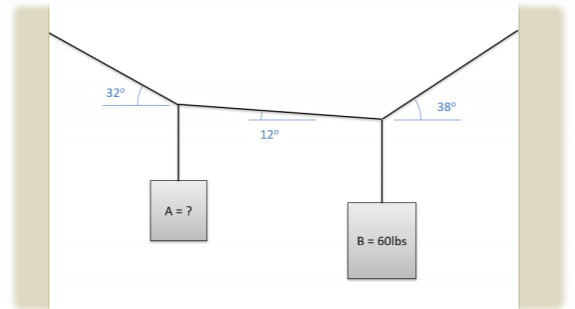
This scenario is two weights suspended from a wire. The left weight is unknown. The right weight (W_right) is 60 lbf. The angle made between the horizontal and the wire connected to the left weight is 32degrees. The angle between the two weights is 12 degrees. The angle to the right of the right weight and the horizontal is 38 degrees.
The right weight and the three angles are set in equations below. The goal is to solve for the left weight.
Solution
Approach
Each point where a weight hangs from the wire is a joint in static equilibrium, so the forces at each joint must add to zero in both x and y. There are three wire tensions: T_left (left wall to A, at 32°), T_mid (A to B, sloping down to B at 12°) and T_right (B to right wall, at 38°). We take +x to the right and +y up.
Joint B has only two unknowns (T_mid and T_right), so we solve it first. With T_mid known, joint A has two unknowns left (T_left and the weight of A).
Step 1: Equilibrium at Joint B (right weight)
Three forces act at B. T_mid pulls up and to the left along the middle wire (12°). T_right pulls up and to the right (38°). W_B = 60 lbf pulls down.
Substituting T_right into the y equation gives T_mid directly:
Step 2: Equilibrium at Joint A (left weight)
Three forces act at A. T_left pulls up and to the left (32°). T_mid pulls down and to the right toward B (12°). W_A pulls down. T_mid is known from Step 1.
Result
weight_left is the weight of block A. Working the numbers by hand gives about 110.7 N (≈ 24.9 lbf). The wire tensions come out to about T_left ≈ 316.7 N, T_mid ≈ 274.5 N and T_right ≈ 340.8 N. Block A is lighter than B because the steeper 32° wire on the left carries more of the vertical load per unit of tension. Part of that lift also goes toward holding up B through the middle wire.